Everlittle · 精灵之森
A rain fairy brings a forest back to life, one flight path at a time.
Personal Project
2026
Solo Developer / Technical Artist
I created Everlittle as a solo developer for the 2026 Epic AI MegaJam. I designed the fairy’s flight so the player has to choose between spending magic on the grove below and flying on in search of another wisp. That choice shaped the forest I built, the patches of green the game remembers and the music I wanted to hear as her flight ends. I developed the game with Codex and Claude in Unreal Engine 5.9 and packaged it for desktop browsers after the jam.
How a forest comes to remember a flight
The last shot of Everlittle became my test for the whole game. A tiny rain fairy spends her remaining magic bringing a dry forest back to life. When her flight ends, a flower opens where she lands and the camera pulls back. I wanted a player to be able to point to the green patches and say, “I did that.” Getting that shot to work shaped how I animated the plants, recorded where the player spent magic, and lit the forest for the final pullback.
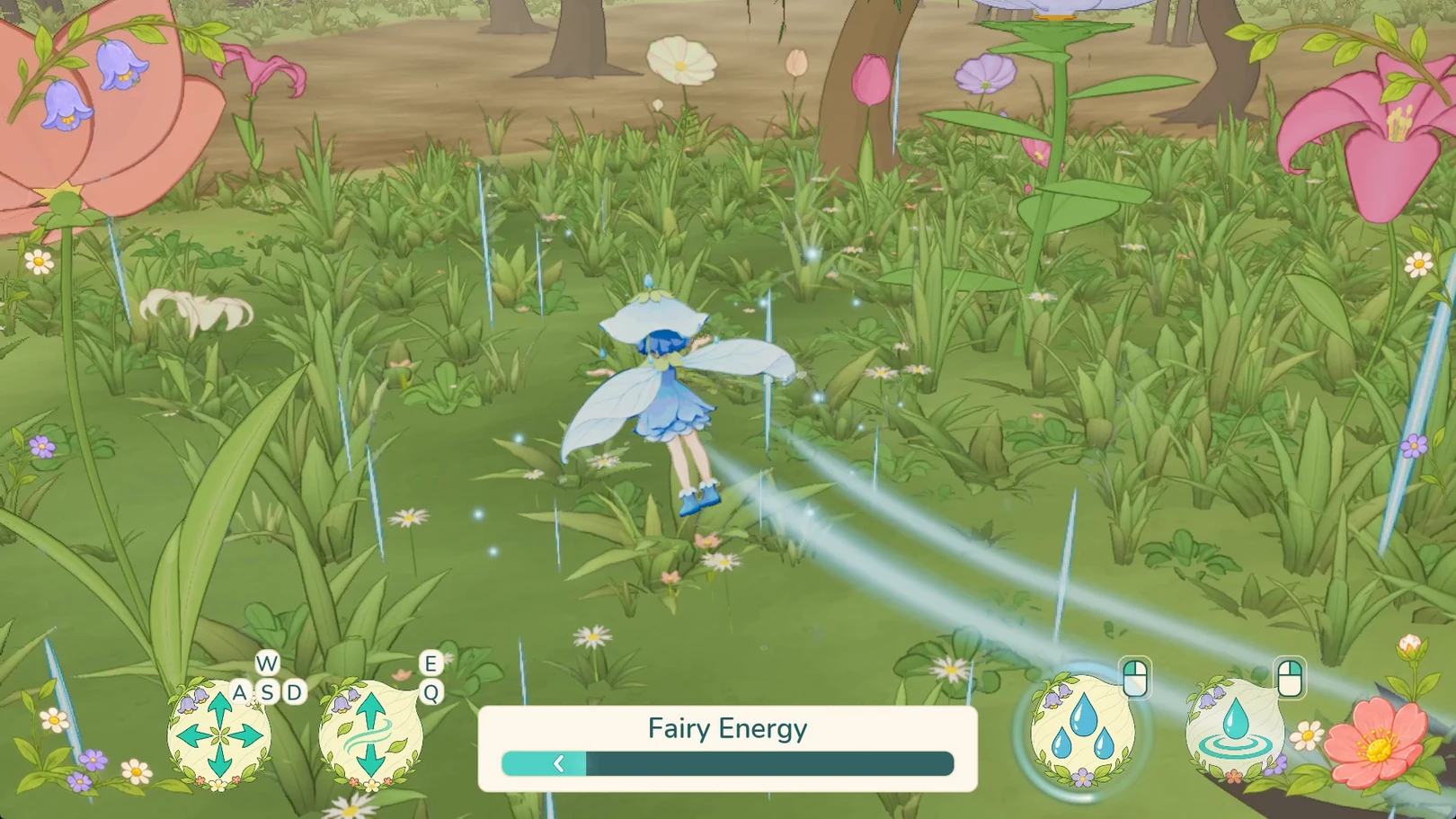 The blue rain fairy flying low through flowering meadow grass, with the flight HUD visible.
Gameplay capture. At the fairy’s height, a flower can fill the frame. The same grove has to read from above at the end of the flight.
What survived the prototype
I explored the jam theme, Director’s Cut, through several prototypes. In one, the player rotated a constellation into alignment. In another, they steered seeds into a glass terrarium. The terrarium gave me a planting style I wanted to keep, but the rain fairy gave the player a choice with a cost. The next wisp might keep you airborne. Spending that magic now might save the grove directly below you. Everyone reaches the same ending, and everyone directs a different final shot.
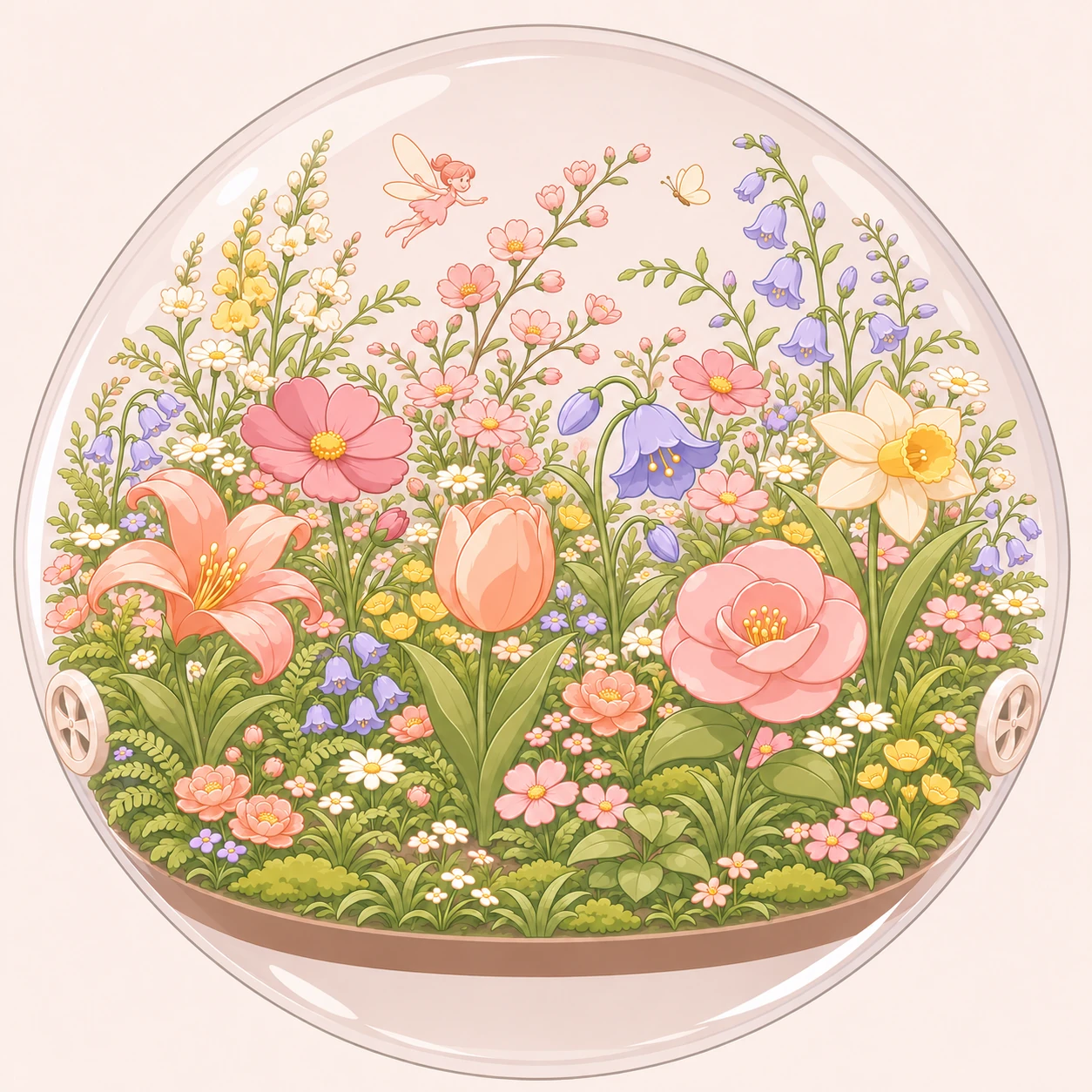 An approved concept painting of a glass terrarium densely planted with tiered flowers.
Early art direction. The terrarium was a concept for a different interaction. Its layered planting and soft cel shading carried forward.
The most valuable part of the terrarium turned out to be its six procedural flowers. I carried their petal shapes and opening curves into the forest. I kept the full procedural flowers for close inspection. For repeated planting I baked 129 frames of vertex animation from the same generator and gave each flower its own start time and palette. I played the original, full and baked versions side by side in Unreal. That gave me a reference for deciding how much detail the cheaper flower could give up at gameplay distance.
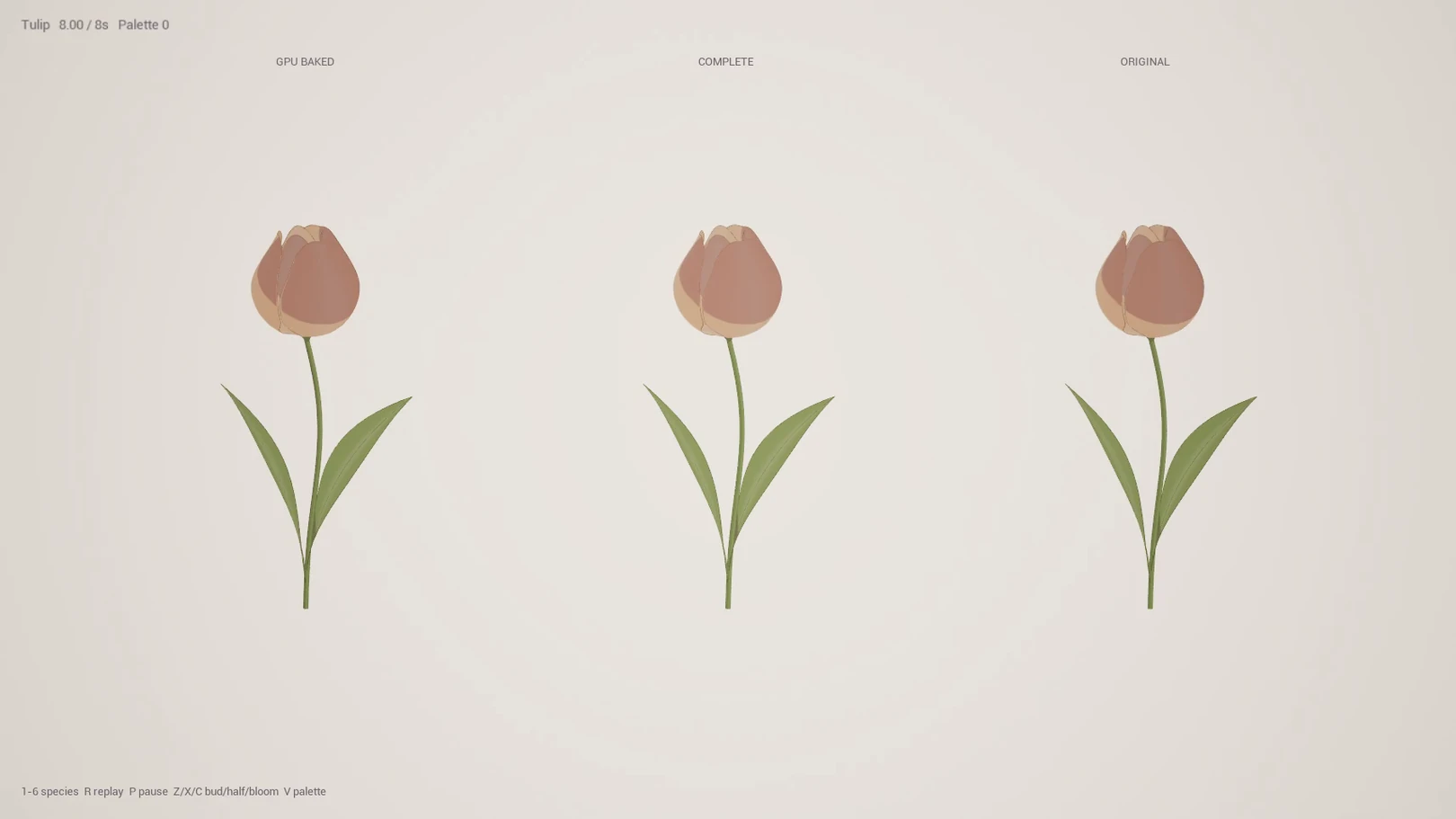 Three Unreal review renders of the same tulip at the same stage of opening.
Unreal review scene. The baked GPU flower, full procedural player and original Terrarium flower share the opening motion. Keeping the reference asset in the scene made differences easy to spot.
When rain counts, and when the player sees it
In an early playtest, rain turned an entire patch green at once. The game had credited the correct area, but I couldn’t see a drop do anything. I wanted the score to update immediately and the player to see each drop reach the soil.
I kept one authoritative record of restored ground. Revisiting a patch costs no extra restoration energy and earns no extra area. The ground material uses its own clock to open small, irregular stains where droplets land. Grass and flowers begin to grow when a stain reaches their roots. Releasing the rain button lets the last drops finish. A cut back over the same ground still shows what you did. That division let me adjust the pace of the effect repeatedly without changing the rules under the player.
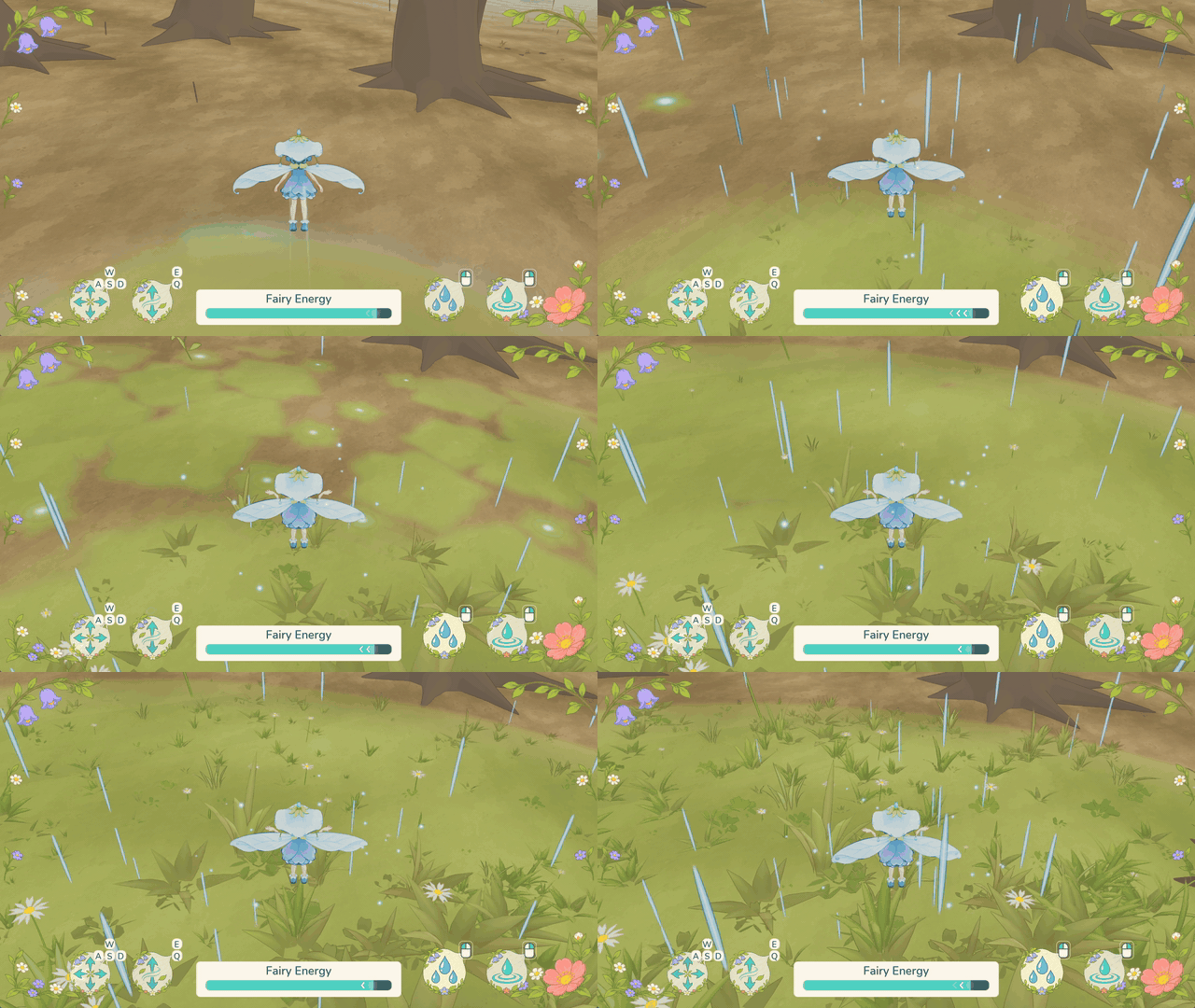 Rain hits the dry soil in scattered spots. The green patches spread and meet before the grass comes up.
Directing development with Codex and Claude
I used one Codex conversation to coordinate work on the game and separate conversations to explore gameplay, vegetation, character motion and presentation in parallel. I kept edits to the main Unreal scene in the integration conversation. That way I could play two versions of an effect against the same forest, pick the one that read clearly in flight and carry it into the build.
Who needed the next message?
The sessions could work in parallel, but they took turns in the shared Unreal Editor. A single editor handoff could send an update to every session in the queue. I was seeing the same news across several chats when only one session could act on it.
I told the coordinator to message only the session whose turn came next. Each session left the asset paths, what it had tested and what still needed checking in a shared handoff file. When the animation pass was ready, the VFX session got the message that it could open the editor and check the bubbles and rain. The other sessions could read the notes when they picked up their own work.
Directing the fairy's movement and music
I started the fairy with front, side and back drawings in the same T-pose. I corrected the overlap between her arms and wings in the reference, then used Tripo3D to generate her mesh and textures. I brought the character into Blender with a Mixamo body rig. When I raised her arms, the elbows pinched. I used Codex to correct the skin weights around the elbows and add three bones to each long wing so it could bend in flight.
For the wave cast I chose a two-handed push. At the fairy's in-game height of 30 cm, the elbows stayed so close to her body that the windup was hard to see. I moved them back before the palms pushed forward, smoothed the jitter in the motion and checked the silhouette from the front and side.
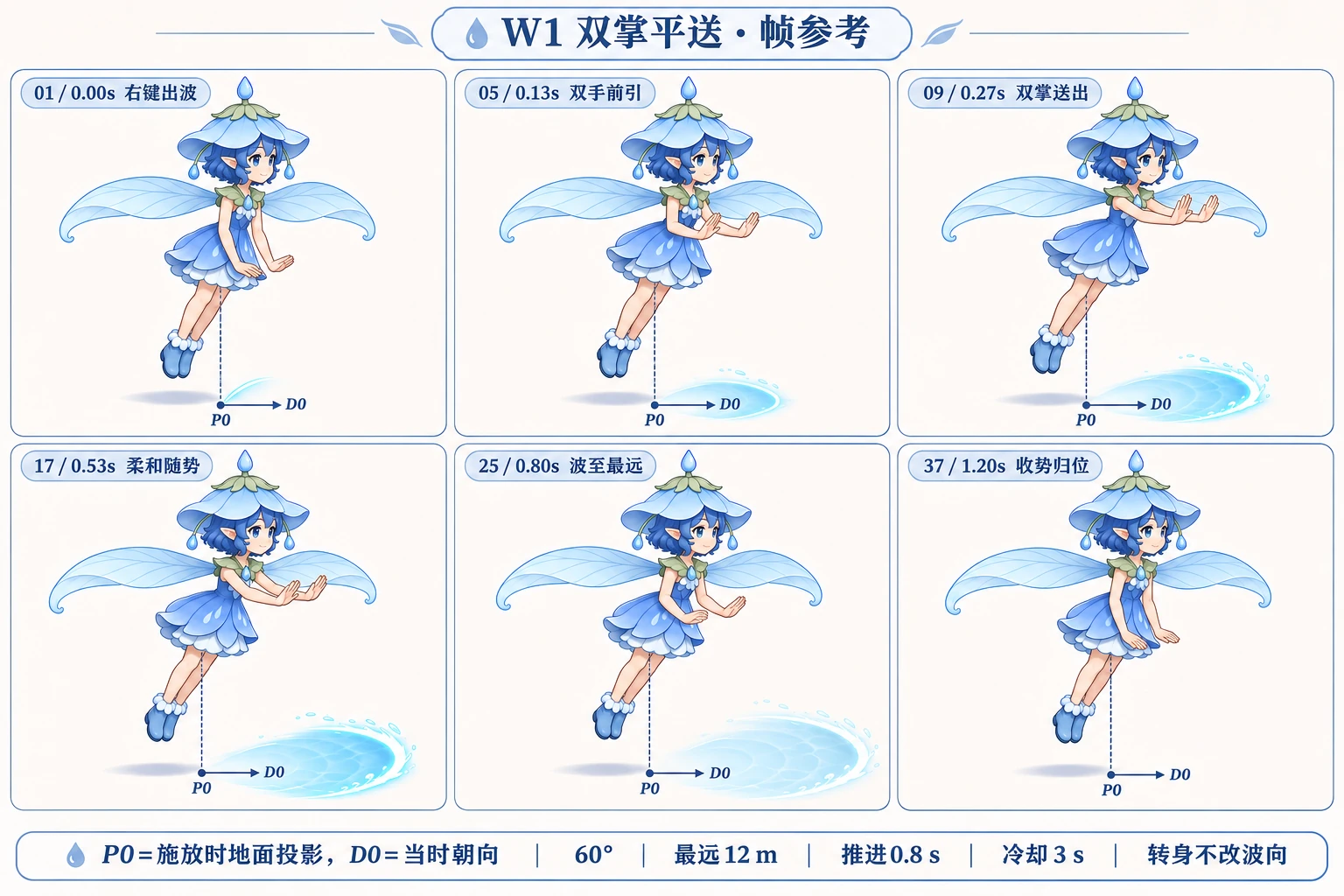 Six illustrated key poses of the fairy pushing both palms forward to cast a water wave.
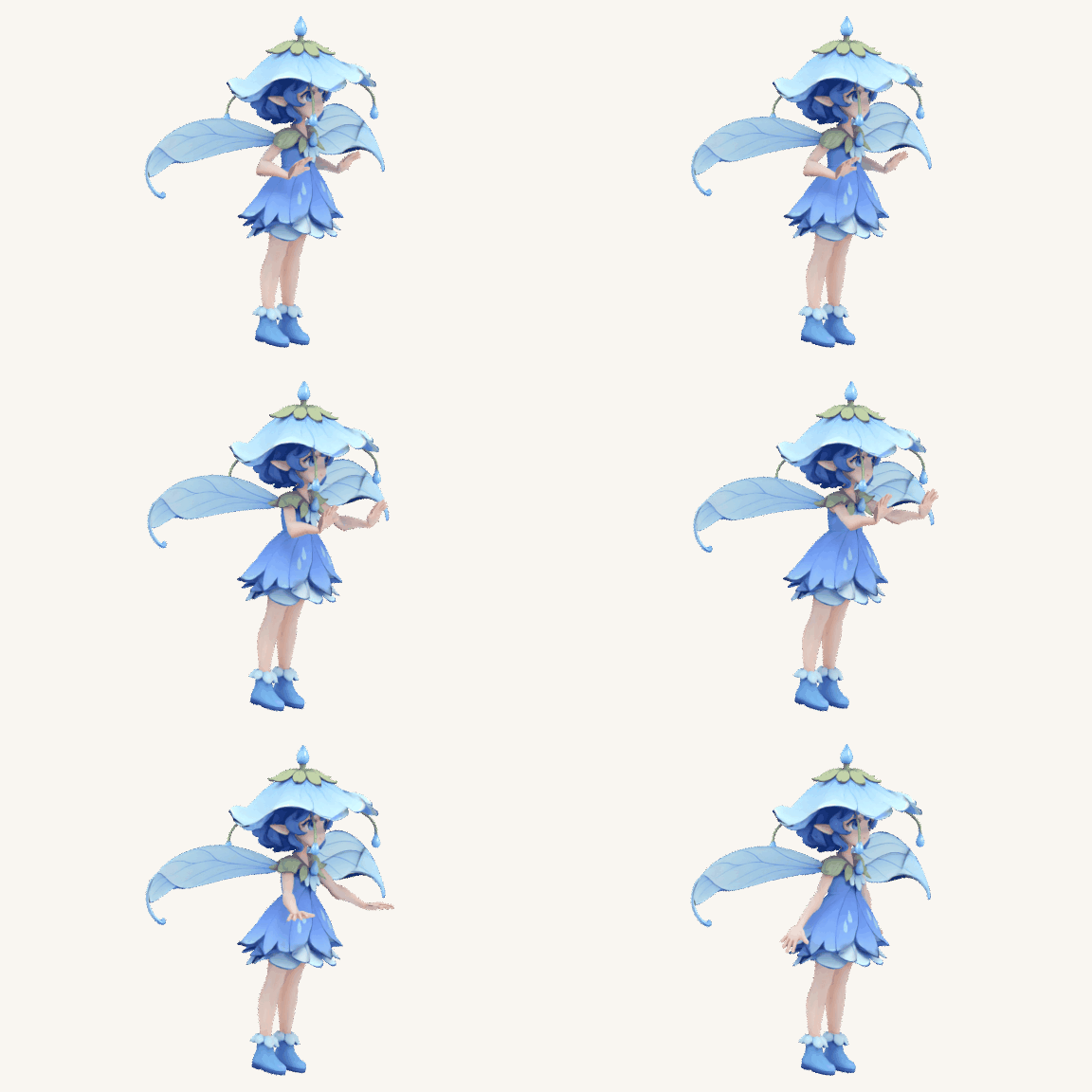 The final water-wave cast on the rigged fairy, facing right in the same three-quarter view as the pose board.
Pose board and final animation. Follow the elbows as the fairy draws her hands in, pushes both palms forward and settles back into flight.
I designed the music around changes in the fairy’s flight. I used Suno to generate five cues and decided where each would enter. A glide can turn back into powered flight, so I made the flight track resume smoothly when the fairy recovered. I used ElevenLabs to shape lighter sounds for her actions, tried each effect against its gameplay event and chose a single click for the UI.
Streaming the forest and remembering where it rained
I wanted the fairy to be able to fly out through any of the starting valley's four edges and keep finding forest. I kept the valley loaded. Beyond it, my C++ system used procedural content generation (PCG) to build terrain and place vegetation in 160-metre tiles. The fairy's tile loaded first, with its neighbours spread over successive frames. I kept an extra ring of recently visited tiles so a quick turn wouldn't immediately rebuild the grove behind her.
Outside that ring I released the terrain, collision, vegetation instances and local ground-mask textures. The restoration record stayed in memory for the whole flight. On a return visit, the same seed rebuilt the grove and the record put the green back where the rain had fallen. Revived plants could reappear without replaying their growth, charging magic or counting the area twice. The ending needed a wider view than the fairy did. I used the same record to draw the whole route across low-detail terrain without collision, with the surrounding forest fading to black.
Would I use World Partition next time?
On November 14, the fourth release candidate (RC04) already generated those tiles and recorded which cells the player had restored. The missing piece was unloading distant tiles. Converting the map to World Partition would still have left me managing the terrain and plants my code created during play. I chose to add unloading to the existing system. That kept the change small, but I owned the cleanup and the bugs. I had to detach plant instances before a tile disappeared, fix a lookup that selected the wrong tile at negative coordinates, and track down a collision cache that gave a distant tile the starting valley's collision.
In the RC05 flight test, the fairy flew 720 metres west and retraced her route. At most 12 detailed tiles were loaded at once, with 33 unloads over the run. The score held steady on the return trip and only the usual flight energy was spent. The final pullback showed 550 restored cells whose detailed tiles had already unloaded. I tested that route on the custom build alone. Its performance relative to World Partition is still unmeasured.
I would make the same incremental change at RC04. Starting fresh, I'd first test how far the fairy could fly with the extra energy available from wisps. I wanted the forest to feel endless. A large, finite Unreal Landscape populated with PCG might have felt just as open. I'd prototype that route with World Partition handling streaming and prebuilt HLODs showing distant trees. If it worked, I'd have less terrain, collision and streaming code to maintain. I'd still need the run's restoration record to draw the player's green route in the final shot. If players could outfly the map, I'd keep runtime terrain generation.
Two post-jam fixes that changed what players could read
Building the water wave in Niagara
The first wave used a procedural mesh driven by C++. I liked the curl in a still, but in motion the crests sometimes bunched up on one side. Players could aim by the visible water and still misjudge which ground their 60-degree cast would reach. I kept the curl when I moved the visual into Niagara. The C++ driver placed a crest in each of four 15-degree bands and passed the positions and terrain heights to Niagara. Letting the crest meshes overlap the bands kept the fan legible while leaving room to vary each crest's height and motion.
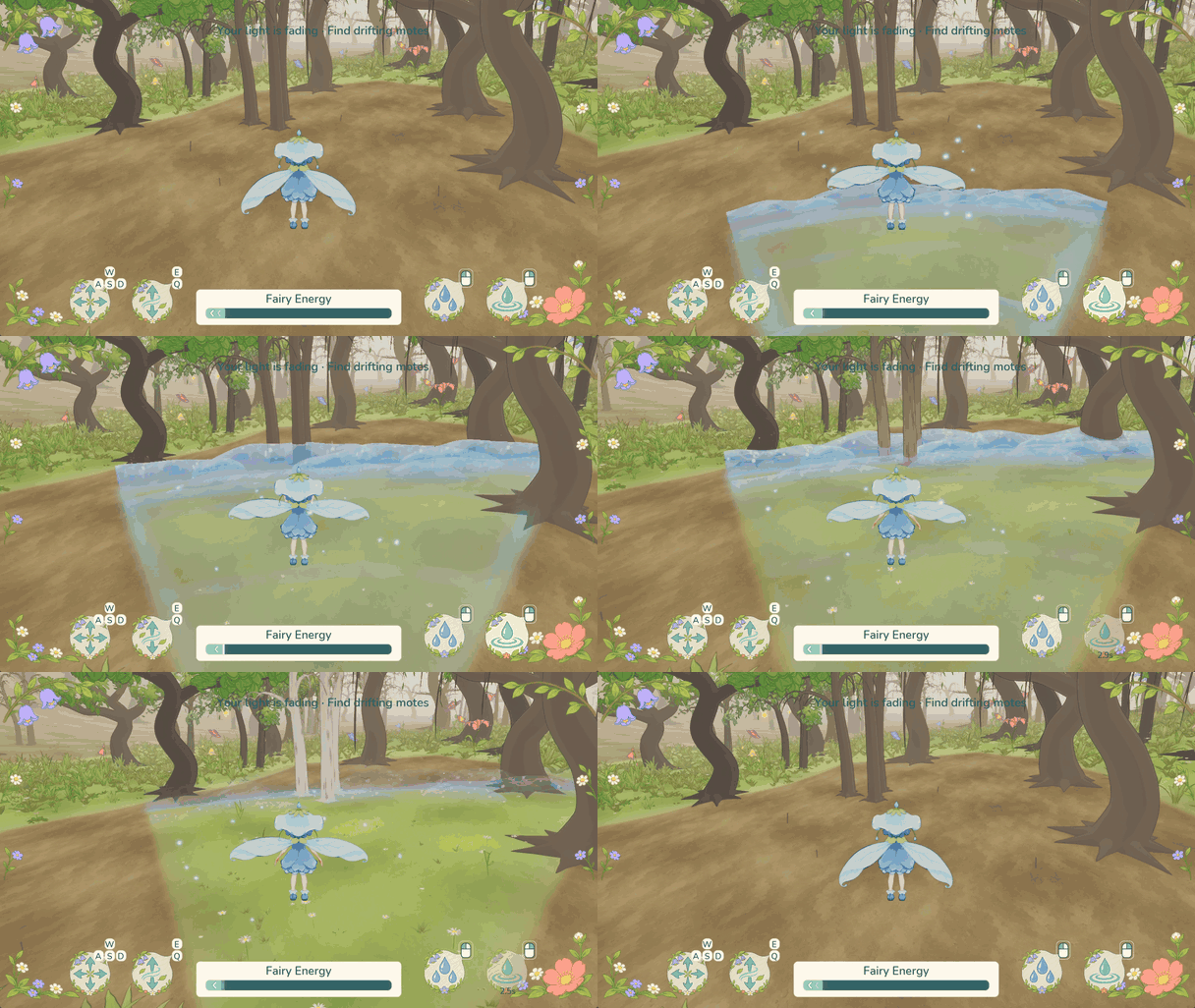 A single cast sends a low blue wave across the clearing. The widening crest traces the edge of the ground turning green.
My AI tools seem to think every problem deserves a C++ class, even the shape of a splash. Next time, my first instruction for a new effect will be “Build the visual in Niagara.” For this wave I'd ask for crest height, travel time and overlap as Niagara parameters from the first pass. Then I could cast, adjust the curl and cast again in the editor. C++ would still decide where the spell lands and which cells earn restoration credit.
Reading foliage at flight height
The trees had the opposite problem. A close-up had plenty of leaves, yet at flight distance the crown broke into hundreds of alternating highlights and outlines. I used the concept art as a target for the larger shapes. In Blender the generator grouped leaves into canopy masses. In Unreal the shader borrowed normals from each mass, and the outline treatment gave more weight to the outside silhouette. On the oak, LOD0 went from 936 leaves and 13,104 leaf triangles to 1,827 leaves and 7,308 leaf triangles. That is a geometry saving. The larger masked cards trade some of it for pixel work, and the browser frame-time impact remains unmeasured.
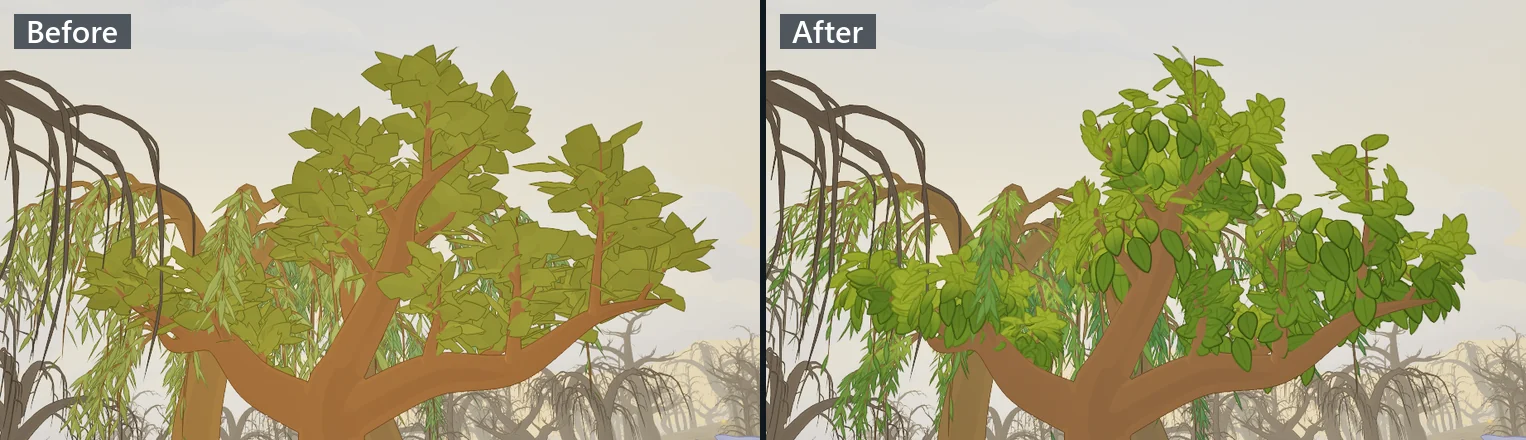 Oak canopy from the same camera. On the right, clusters of leaves give the crown a clearer silhouette against the sky.
At the fairy's height, a single grass blade can cross her wings. I reshaped the grass cards in Blender and used the ground-cover material to draw their edges. On the landing flower I placed the veins using each leaf's UVs. For the animated meadow flowers, I carried surface UVs through the vertex-animation bake so the material could follow each species' exposed petal edges as the bloom opened.
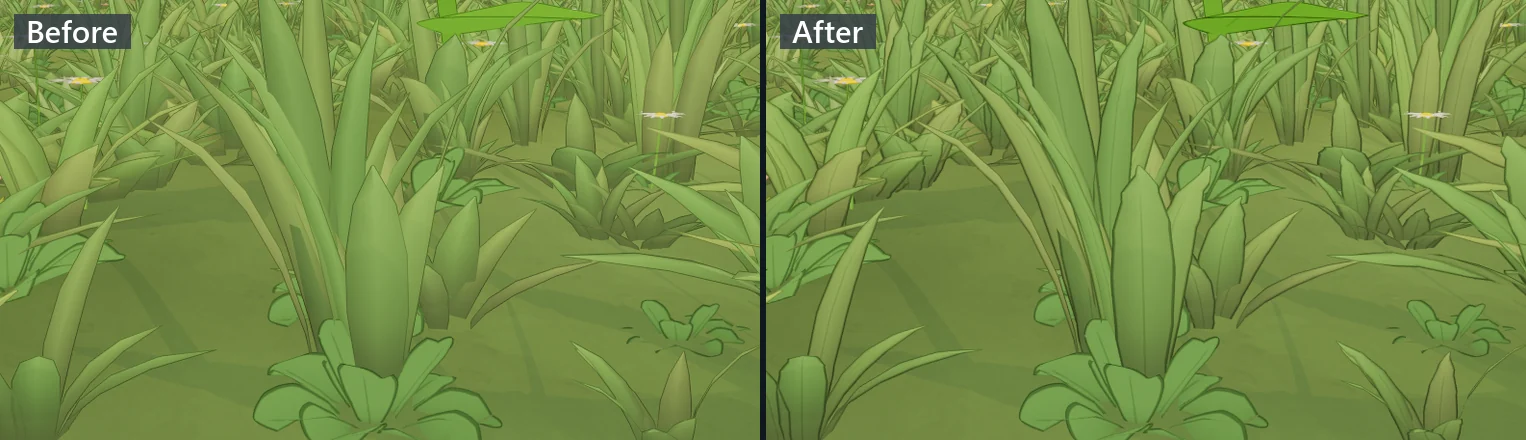 Meadow grass. A tapered outline separates each blade from the tuft behind it.
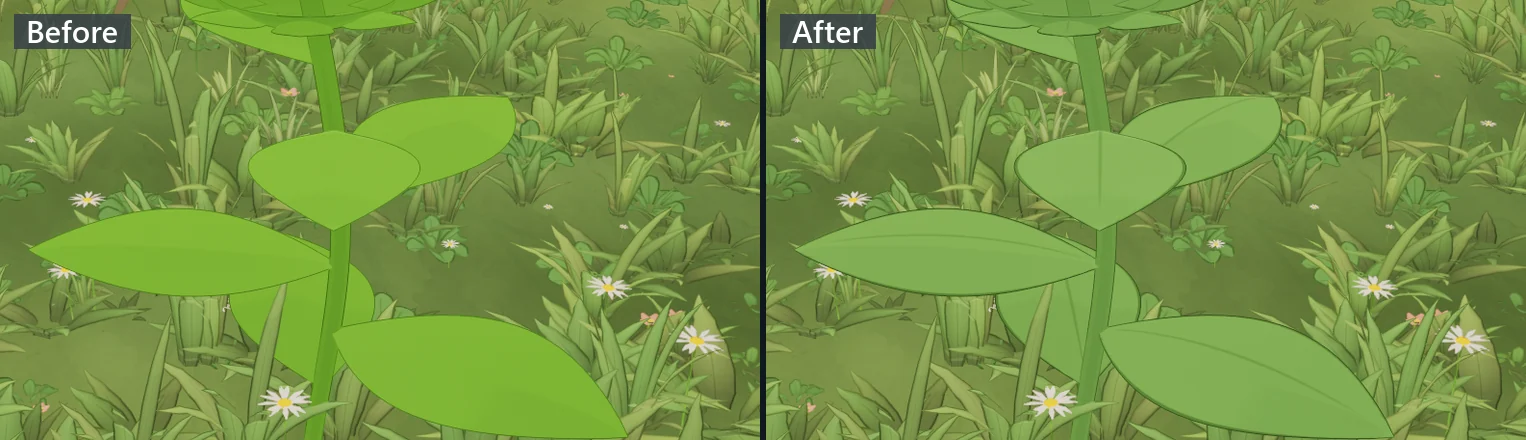 Leaves on the landing flower. The softer green and central vein make the overlapping leaves easier to follow.
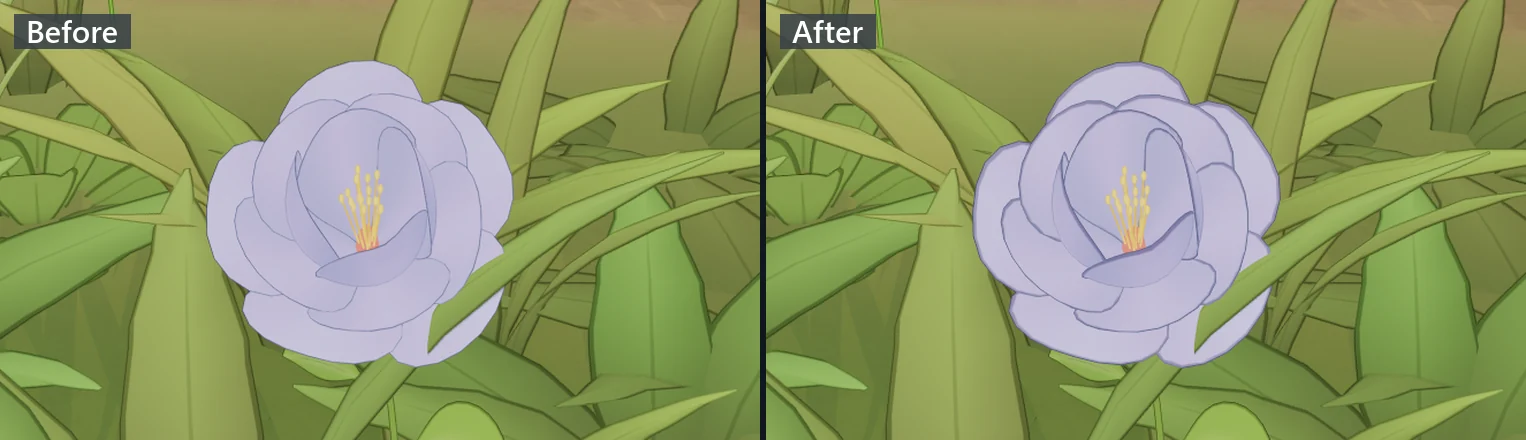 Camellia petals. A fine line follows each exposed rim and shows how the petals overlap around the yellow stamens.
Packaging UE 5.9 for the web
I submitted RC08 for Windows on itch.io for the jam. Afterward, I packaged the same Unreal Engine 5.9 project for the web as a multithreaded WebAssembly build. Its worker threads needed shared memory, so Harmony had to enable cross-origin isolation on both the game and the page that embedded it. Once that was in place, I played through to the finale in the browser.
That run exposed an art problem a ground-level playtest had missed. Fog tuned for a camera near the grass washed out the restored areas from high above. Fading the height fog during the climb let the route come back into view.
For the trailer I flew a heart-shaped route and held the aerial shot long enough to see its outline. In the first edit the growth close-ups took too much time away from the player. I shortened them to the moment the petals or blades opened, then cut back to the flight that had caused it. That edit sums up what I’d change in my next production. I’d record one playable path on the target build much earlier, with a low flight, a repeated cast, a landing and a pullback. It would have surfaced the wave coverage, canopy distance and fog issues in the same review.
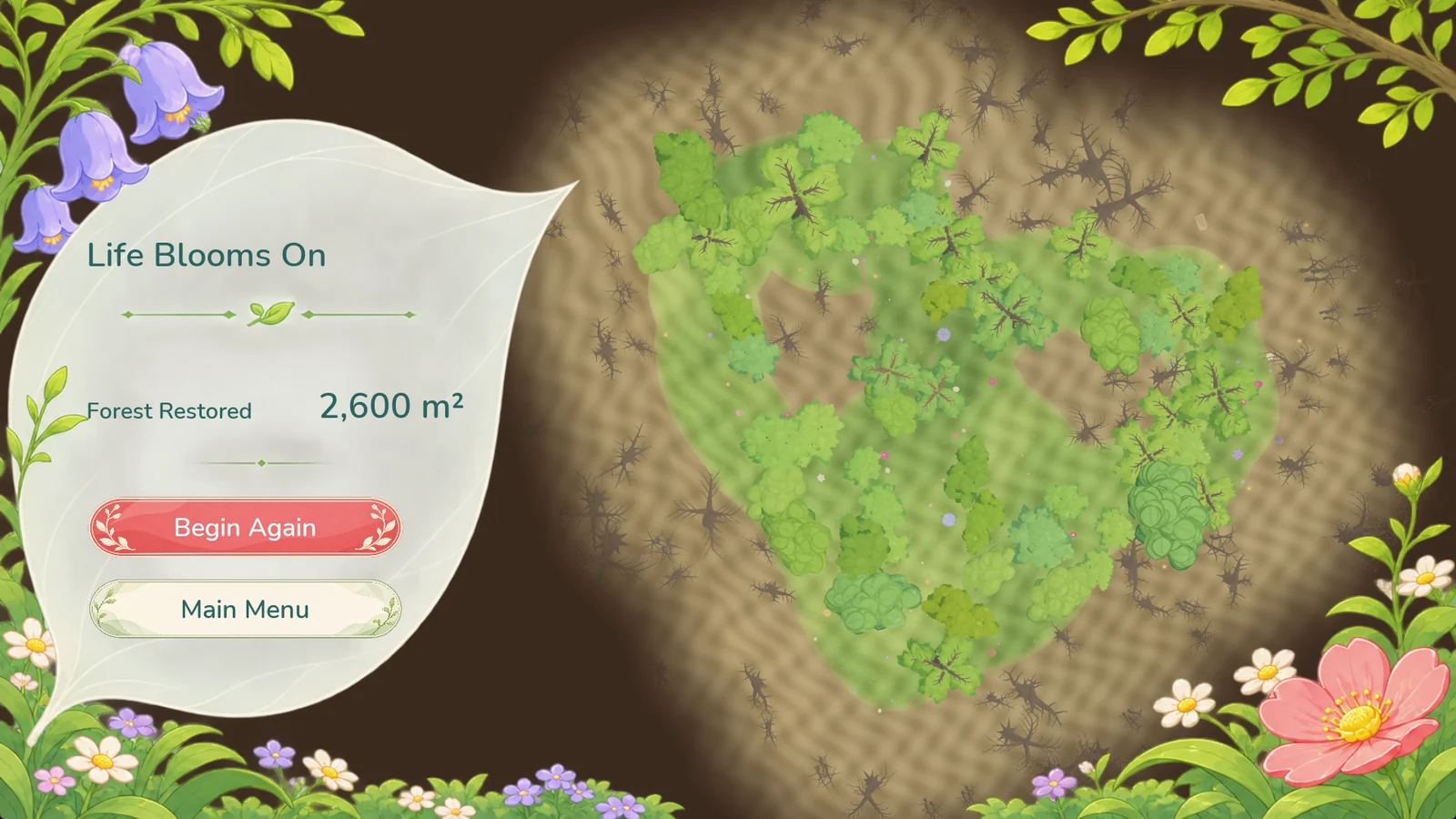 The “Life Blooms On” results screen shows the heart I traced on this flight and the 2,600 m² of forest I restored.