Universe2D: STARWELD
WIPA 2D space exploration and industry game with visible cargo, orbital logistics, and procedural planet rendering
Personal Project
2026
Solo Developer / Technical Artist
Context
STARWELD is a single-player browser game about exploring a hidden star map and building an interplanetary industry. Players pilot a cargo ship, establish outposts, connect orbital transport networks, and manufacture the cores needed to restore a stargate.
My Contribution
Directed and developed the game through an AI-assisted workflow, covering game design, art direction, procedural Canvas rendering, flight and freight systems, contextual UI, localization, save compatibility, and validation.
Impact / Outcome
Built a playable exploration-to-industry loop while connecting visual feedback to the underlying simulation: players can inspect where materials are, why a facility is waiting, and what a construction site still needs. The project remains in active development.
Outcome Summary
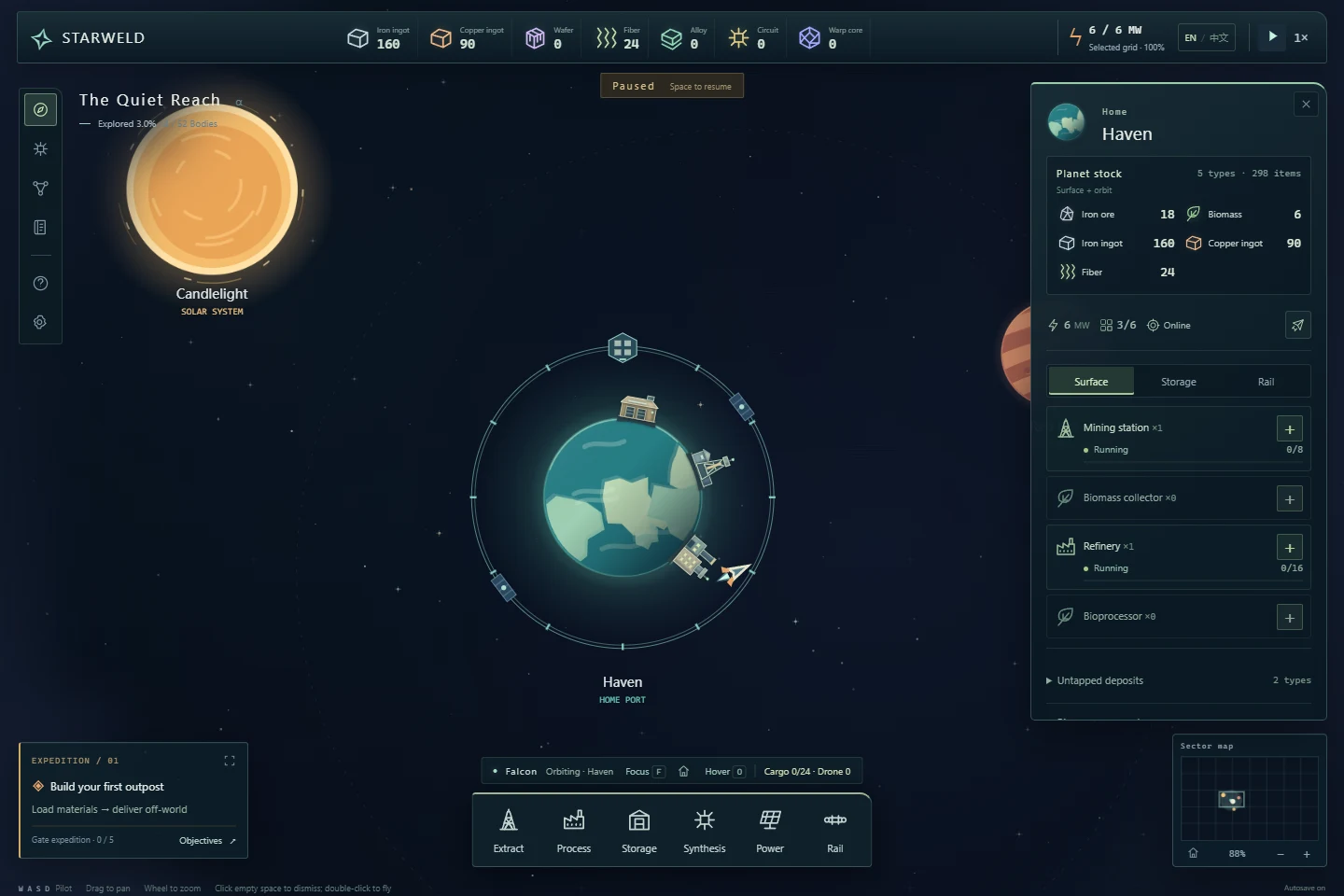
From Exploration to Industry
Play STARWELD in your browser — WIP, with English and Chinese support.
Universe2D, released under the game name STARWELD, brings quiet space exploration and industrial automation into a single 2D world. Piloting the ship reveals the star map a little at a time. Different planets provide different resources; mining and refining establish the first supply chains, while independent space stations manufacture more complex products.
The progression starts with hands-on cargo delivery. The player transports construction materials to the first outpost, then builds drones and orbital rail connections to expand the network. The longer-term objective is to manufacture and deliver six warp cores, then approach and repair the stargate.
My focus is the connection between the simulation and its presentation. A planet should communicate its resource identity, a delivery should visibly travel through the world, and a stalled building should explain what is missing.
Procedural Art and Canvas Rendering
The game uses a custom JavaScript and Canvas 2D renderer, with HTML/CSS panels and SVG interface icons. It runs as a static browser application without a runtime game-engine dependency or a server API.
The visual direction combines a dark navy star field, restrained atmosphere, graphic planet shapes, and compact industrial silhouettes. Planet surfaces are generated from seeded parameters and cached for reuse. Surface rotation is separated from lighting and orbital structures, so the terrain can turn while shadows, stations, and cargo routes remain visually stable.
The simulation advances at a fixed 30 Hz, while rendering follows requestAnimationFrame. Separating these responsibilities lets production, delivery, and construction share a consistent simulation clock while the camera and scene redraw at the browser's cadence.
Making Logistics Visible
Materials occupy specific places: a surface warehouse, an orbital depot, a ship's hold, a construction site, or a shipment in transit. Storage has finite capacity, and incoming deliveries reserve space. Goods must reach their destination before they can be used.
That model drives the visual feedback. Cargo follows orbital paths; drones turn, travel, dock, load, and return. Selecting a production facility exposes its actual supply sources and routes. Construction markers show missing materials and fill only when deliveries arrive, then switch to a separate build-progress state.
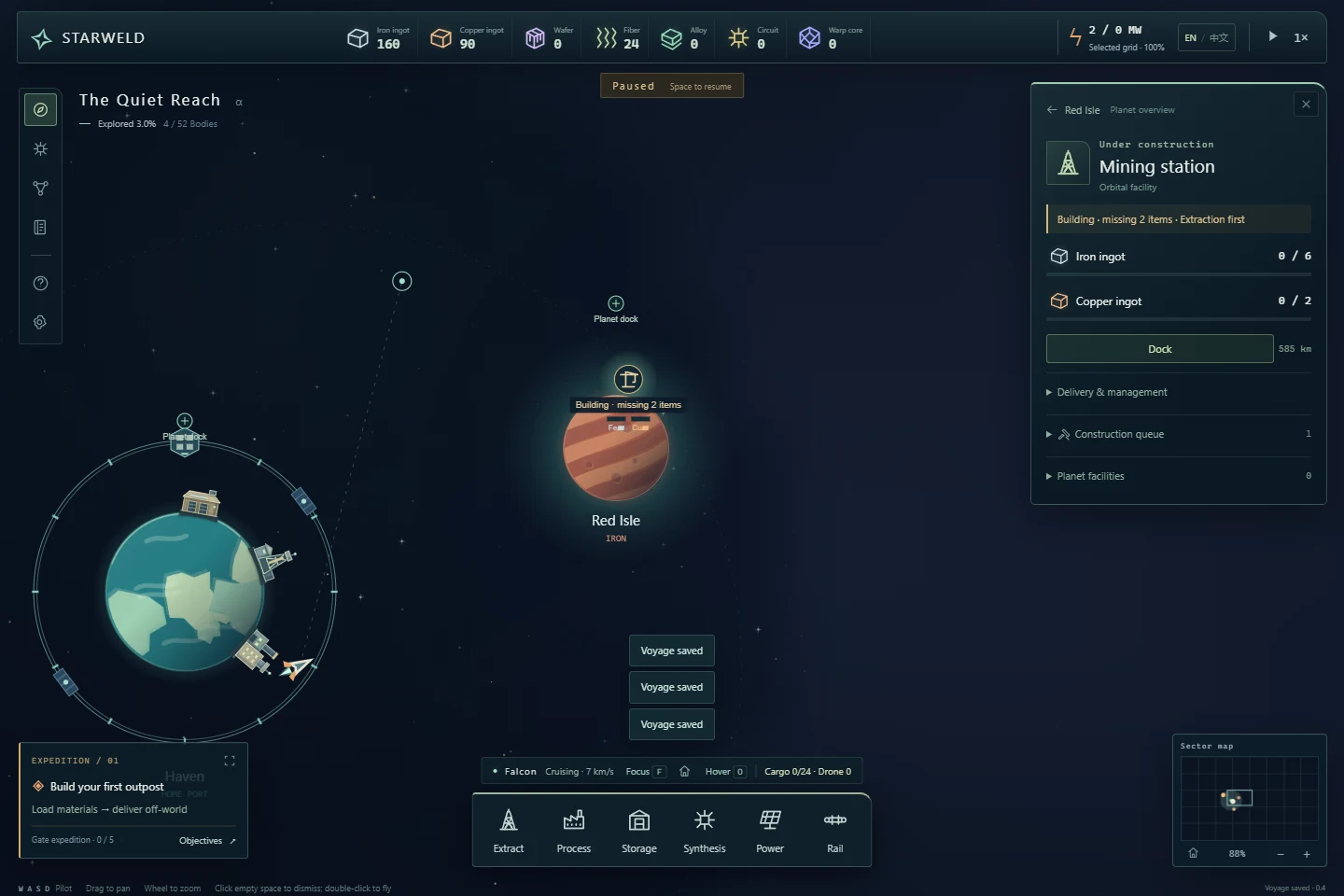 An early mining outpost waiting for iron and copper ingots. The world marker and inspector report the same delivery requirements.
Cancellation also respects physical state. Materials already aboard a ship remain there, and delivered leftovers require recovery. This keeps the interface consistent with what players can see in the world and makes transport constraints part of the game.
A Readable Interface for a Growing System
As the economy grew, long management lists competed with the star map. I reorganized the interface around a compact resource bar, a construction toolbar, a planet overview, and a contextual facility inspector. Recipes use resource icons, quantities, and flow arrows; advanced supply settings and batch details expand on demand.
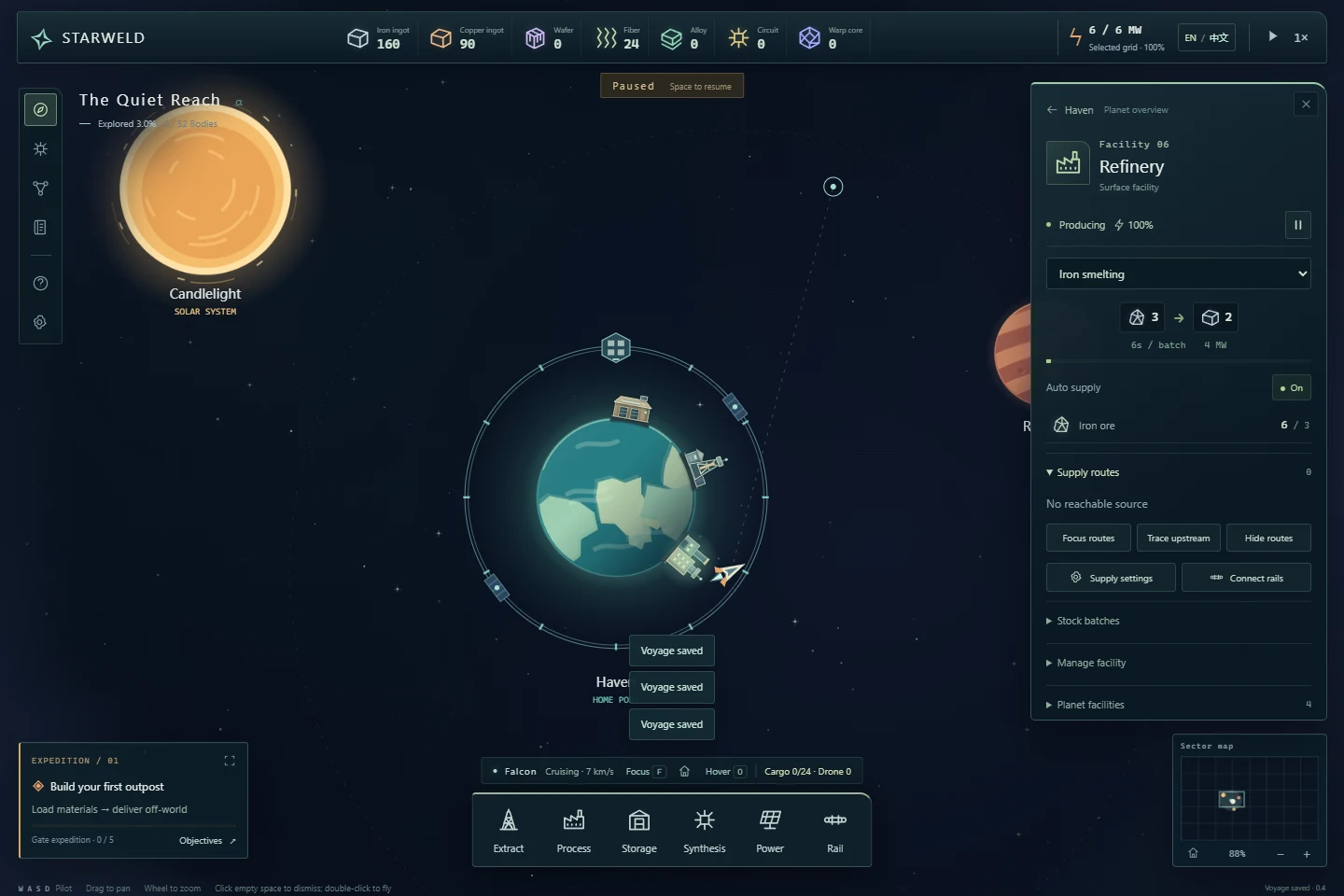 The refinery inspector presents its recipe, production state, input stock, and supply controls beside the running world.
Interaction follows the same principle. Clicking empty space dismisses panels; double-clicking sets a flight destination. Docking beacons provide direct access to cargo handling. Cargo and fleet panels allow the simulation to continue, while larger management screens pause it. English is the first-run default, with an in-game Chinese language switch.
Iteration, Validation, and Current Scope
I used AI assistance for implementation and iteration while maintaining the design documents, art direction, and acceptance criteria. The development record covers complete freight and construction flows, save migration, and UI checks at desktop and narrow-screen widths. The October 6, 2026 validation record reports 85 passing model tests and 10 passing browser workflows, including the industrial progression and bilingual controls.
Save compatibility is part of that work. New versions use separate save slots and preview migration before writing converted data, preserving the original save. Progress stays in the visitor's browser and can be exported or imported through settings.
STARWELD remains WIP. The current scope is single-player exploration, local production, freight, and stargate progression. The simulation pauses when the page is hidden; it does not currently include offline production. The project demonstrates how procedural art, clear interaction, and inspectable game systems can support one coherent playable experience.
Related Projects
 WIP
WIPRoad Trip: Ahead One
Personal Project · 2026
A browser-based idle and companion game supported by art-directed procedural worlds and an AI-assisted 3D asset pipeline
Impact
Built and publicly released a playable road-trip game while developing a reusable approach to procedural art direction, AI-assisted asset integration, runtime diagnosis, and safe content iteration. Visual refinement and broader performance validation remain in progress.
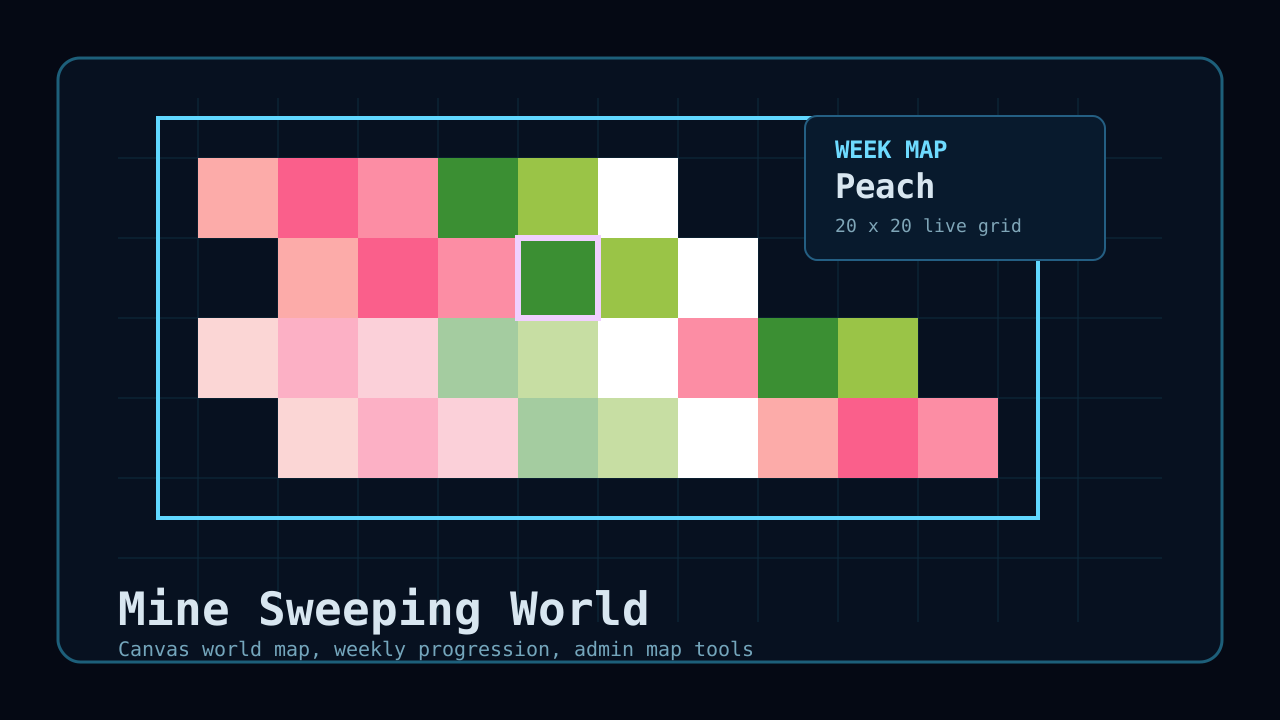
Mine Sweeping World
Personal Project · 2026
Web-based minesweeper world with weekly maps, persistent progression, and admin authoring tools
Impact
Turned a simple Minesweeper prototype into a live, persistent web game and a production-style exercise in systems thinking, tool building, deployment debugging, and AI-native rapid iteration.