n'Space Immersive Projection System
Naked-eye immersive projection system with Unreal-powered interactive content
Archifiction Inc.
2017
Content Group Lead / Technical Artist
Context
An immersive projection system that transforms physical rooms into naked-eye interactive 3D environments, combining custom projection hardware, Unreal Engine content, gesture interaction, and a production content pipeline.
My Contribution
As Content Group Lead and Technical Artist, I helped build the content team, established the UE4 production workflow, authored shaders and VFX, developed reusable asset/plugin systems, supported hardware-software integration, and delivered 15+ interactive projection projects across commercial and exhibition use cases.
Impact / Outcome
Established a scalable content pipeline for a custom immersive projection product, enabling repeatable project delivery, improved vendor collaboration, and more robust hardware/software integration across commercial installations.
Outcome Summary
n'Space Immersive Projection System
n'Space is an AI-driven 3D communication terminal designed to transform ordinary rooms into naked-eye immersive interactive environments, without requiring wearable devices. Users can interact with virtual spaces through body movement, gesture input, and optional mobile controls.
This article highlights selected work I contributed between 2017 and 2020 as Content Group Lead and Technical Artist.
Table of Contents
- Content Creation Workflow
- 15+ Interactive Projection Projects Across Multiple Domains
- Asset Library and Plugin Development
- Outsourcing Vendor Management and Art Direction
- Hardware-Software Integration and Optimization
- Other
Content Creation Workflow
We built the content team from the ground up, growing from early in-house prototyping to a six-person production team with a repeatable outsourcing pipeline. Over several years, we evaluated multiple content creation approaches and technical workflows to find the best fit for our custom immersive projection system.
The content pipeline started in Unreal Engine 4. Our team was based in Salt Lake City, and the initial content group came from my graduate game studio at the University of Utah. Because the product was still in an early R&D stage, we began with rapid prototypes focused on abstract spatial interactions before moving into fully realized 3D environments.
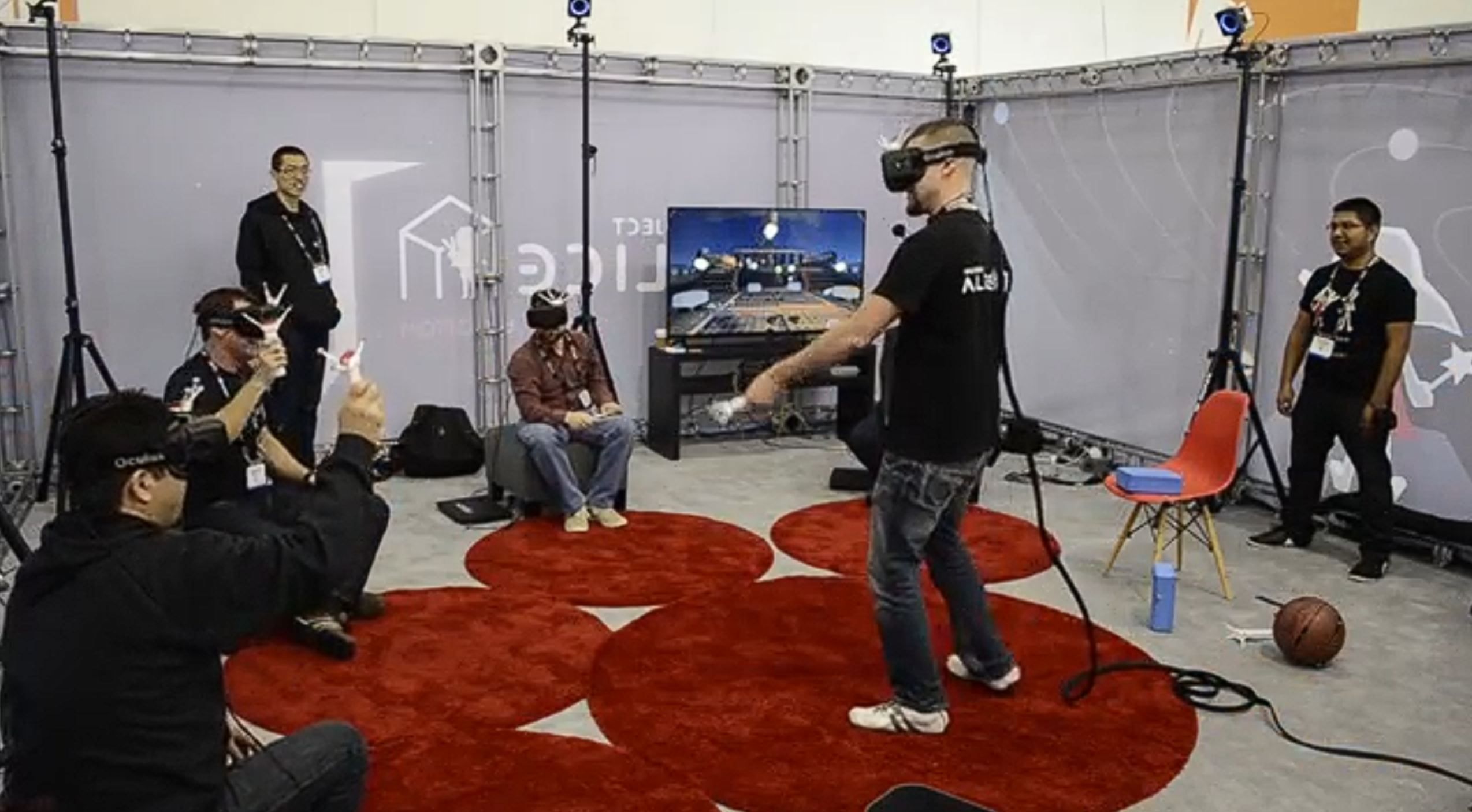
All major tests were conducted in our physical cave lab: a cube-shaped projection room with four walls and a floor coated in specialized projection paint, with the projection machine mounted at the top center of the space.
From a content perspective, building for n'Space shared many challenges with VR production, but required deeper compatibility with custom hardware. Performance was a constant priority, because stable high frame rates are critical for immersive experiences and user comfort. Since content was projected onto five physical surfaces from different directions, every virtual camera had to remain visually consistent. Many standard screen-space techniques did not translate well to this format, so we adapted those effects into location-based or projection-aware systems.
As the only Technical Artist on the team, I was responsible for shaders, VFX, and many interaction/gameplay systems across multiple projects. Before Unreal's modern PCG framework was available, we used Houdini to author procedural mesh generation tools and integrated .hda assets directly into UE4.
Establishing a reliable immersive content pipeline was a major milestone. After repeated research, testing, and production delivery, we continued refining the workflow as more projects reached completion.
15+ Interactive Projection Projects Across Multiple Domains
After the early abstract interaction tests, we built a wide range of projects to explore the expressive range of the n'Space hardware and identify the strongest audiences and client use cases.
We started with virtual apartment and showroom experiences, since immersive real-estate tours and architectural visualization were a clear commercial fit. These projects supported interactions such as day/night cycles, lighting scenarios, construction material swaps, furniture set replacement, and selectable skybox views. Most interactions could be triggered without external devices; based on client feedback, we also added a mobile control panel for more explicit presentation control.
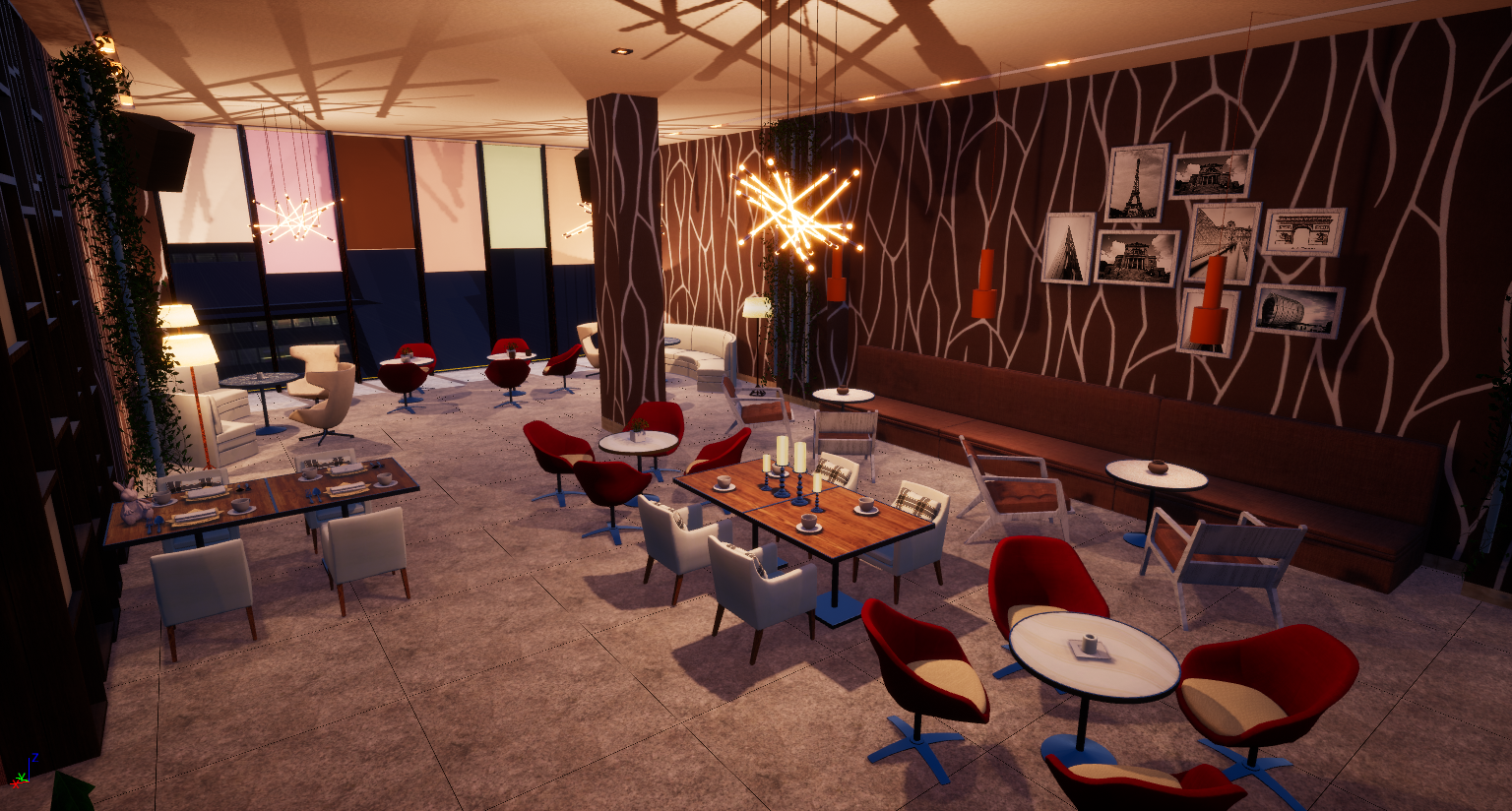 Virtual apartment layout and lighting scenario
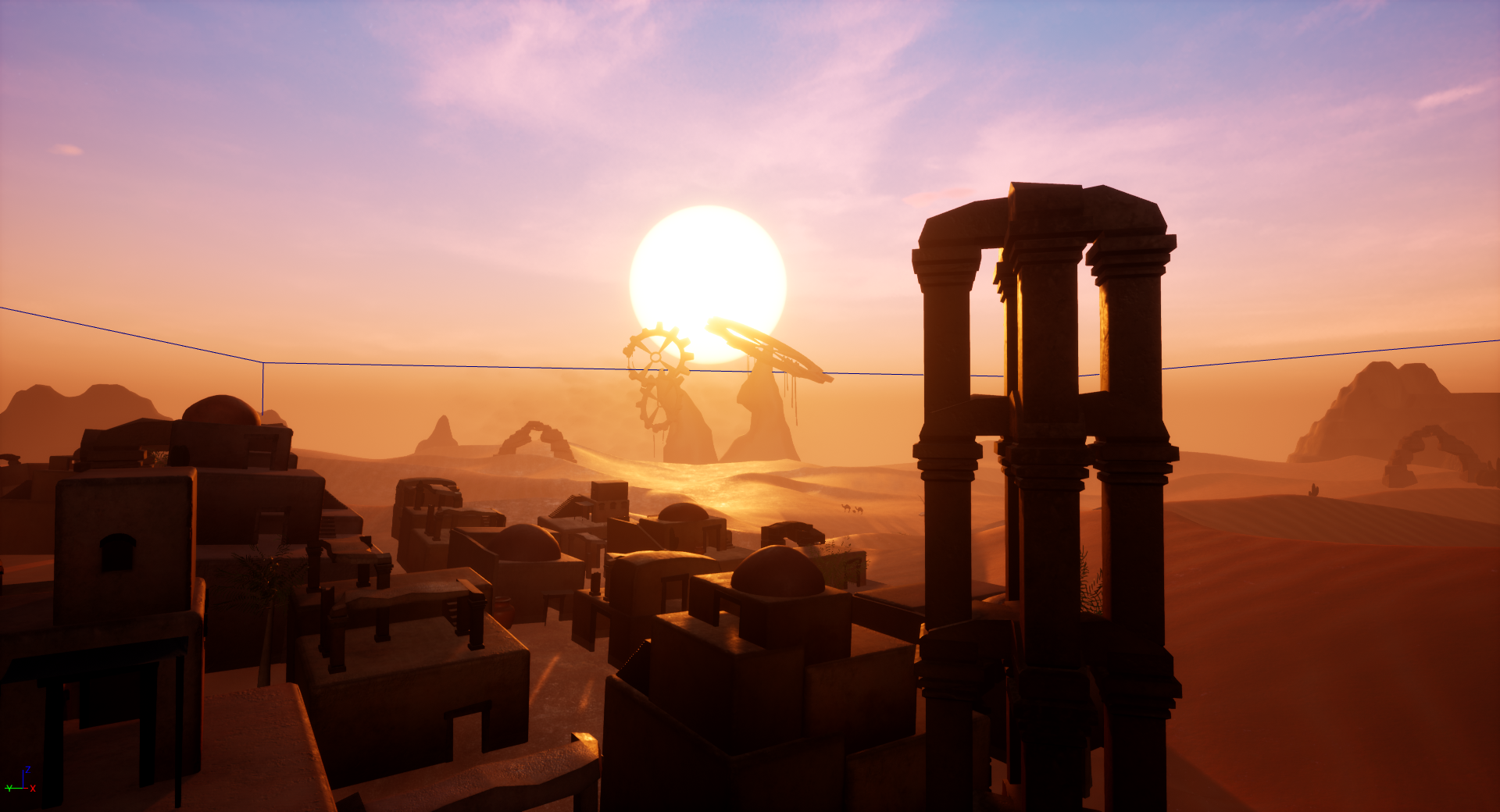 Desert scene material and lighting study
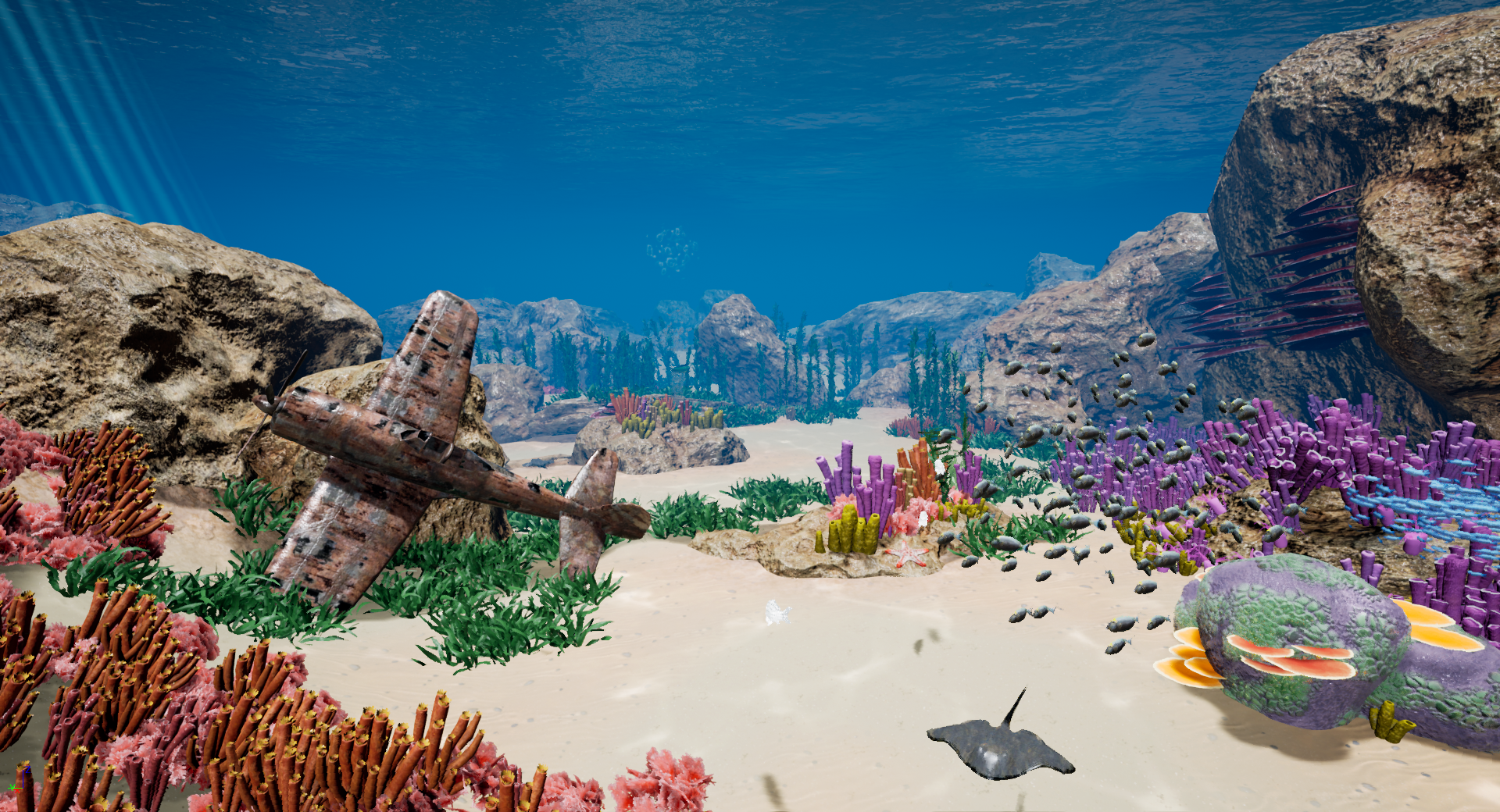 Underwater scene with height fog, color grading, and info system
We then expanded into environments that are difficult or impossible to experience in daily life: a garden with seasonal transitions, a volcano with flowing lava, a tropical lake, a lost desert city, a glowing underwater cave surrounded by fish and sharks, and a modern space station orbiting Earth.
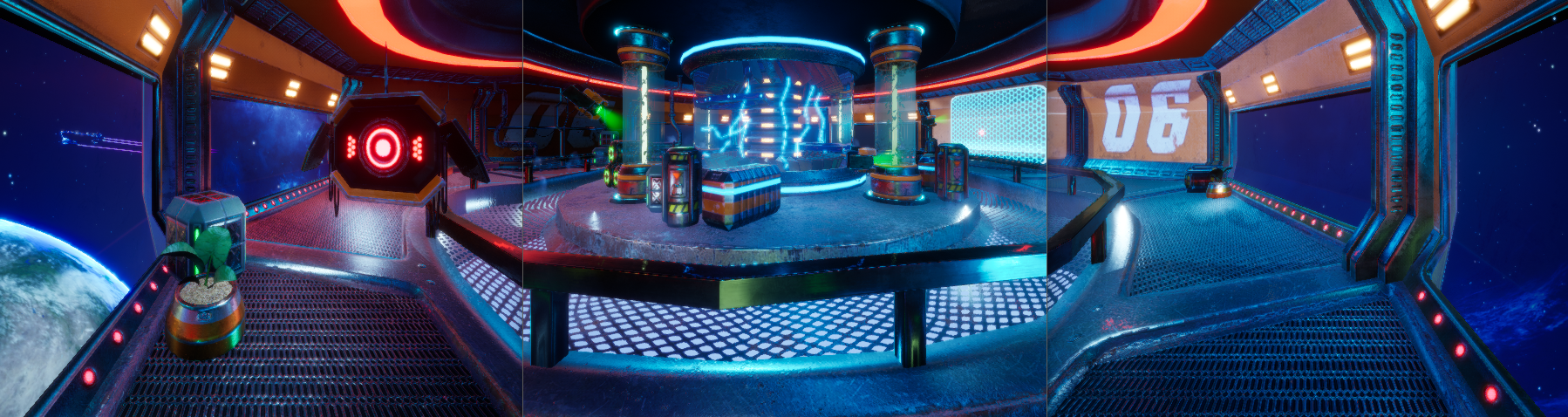 Space station environment with Earth vista, VFX, and lighting
n'Space was not limited to environmental showcases. After an internal brainstorm, we prototyped a virtual anime concert, which opened the door to more entertainment-focused projects such as a 360 video player, virtual KTV rooms, dance-party experiences, and interactive games. One game installation was deployed in a shopping mall and became popular with guests across a wide age range.
Asset Library and Plugin Development
As the number of projects increased, we saw repeated use of many assets, interaction patterns, and technical components. To reduce duplication and improve maintainability, we started building an internal asset library and shared plugin framework.
Frequently reused elements were generalized into data-driven assets with documentation for future use. This included mesh props, master materials, Niagara systems, control blueprints, Houdini tools, and reusable interaction components.
Core system functionality was separated into a base plugin that could be added to new projects, allowing each project to start with the required n'Space integration already in place. This improved production efficiency, made maintenance easier, and gave the team a more scalable foundation for future content.
Outsourcing Vendor Management and Art Direction
We introduced outsourcing after receiving our first commercial order. Client-facing projects required a higher and more consistent quality bar than early internal R&D, so vendor production became an important part of the pipeline.
During vendor collaboration, we gradually established formal art and interaction guidelines. Beyond the technical constraints described above, each project also needed careful level design to fit the cave showroom's physical structure. For example, environments had to feel spatially extended rather than flat, even though they were projected onto fixed room surfaces.
Because the system projected content from above, interactive objects needed to stay below certain height limits, and points of interest had to be arranged around the central cave area. Standardizing these constraints into clear documentation was essential for making vendor work more predictable and production-ready.
Hardware-Software Integration and Optimization
n'Space was a complete immersive experience system spanning real-time content, cave construction, projection hardware, and the central control software. As Content Group Lead, I worked closely with the hardware and system teams to ensure that delivered content functioned reliably inside the full product environment.
Final projects were packaged as executable builds for delivery. We spent significant effort optimizing UE4 packages for runtime stability and performance. The control system launched the content executables and exchanged heartbeat signals with the main control unit so the system could monitor application status.
Over time, we added gesture control and mobile control modules, which increased system complexity and made cross-department robustness an important production goal. By the time I left Archifiction, the product had a more stable monitoring system and a scalable foundation for supporting new categories of immersive projects.
Other
This case study focuses on the content production pipeline and technical-art responsibilities behind n'Space. Additional project media, installation photos, or breakdowns can be added as they become available.