Project Alice
High-end multi-user VR platform with tracked props and full-body motion capture
Noitom Beijing
2016
Technical Artist Intern
Context
A high-end B2B immersive VR and motion-capture platform by Noitom, combining HMDs, inertial motion-capture suits, optical tracking, motion gloves, tracked physical props, and backpack computers for multi-user interactive experiences.
My Contribution
During a three-month Technical Artist internship, I created Unity-ready assets, shaders, VFX, and setup work for two Project Alice demos: a low-poly last-stand FPS demo and a stylized system-accuracy showcase focused on tracked throwing interactions.
Impact / Outcome
Contributed production-ready technical art assets and effects for demos that showcased Project Alice's multi-user VR, tracked prop, and motion-capture capabilities.
Outcome Summary
Project Alice
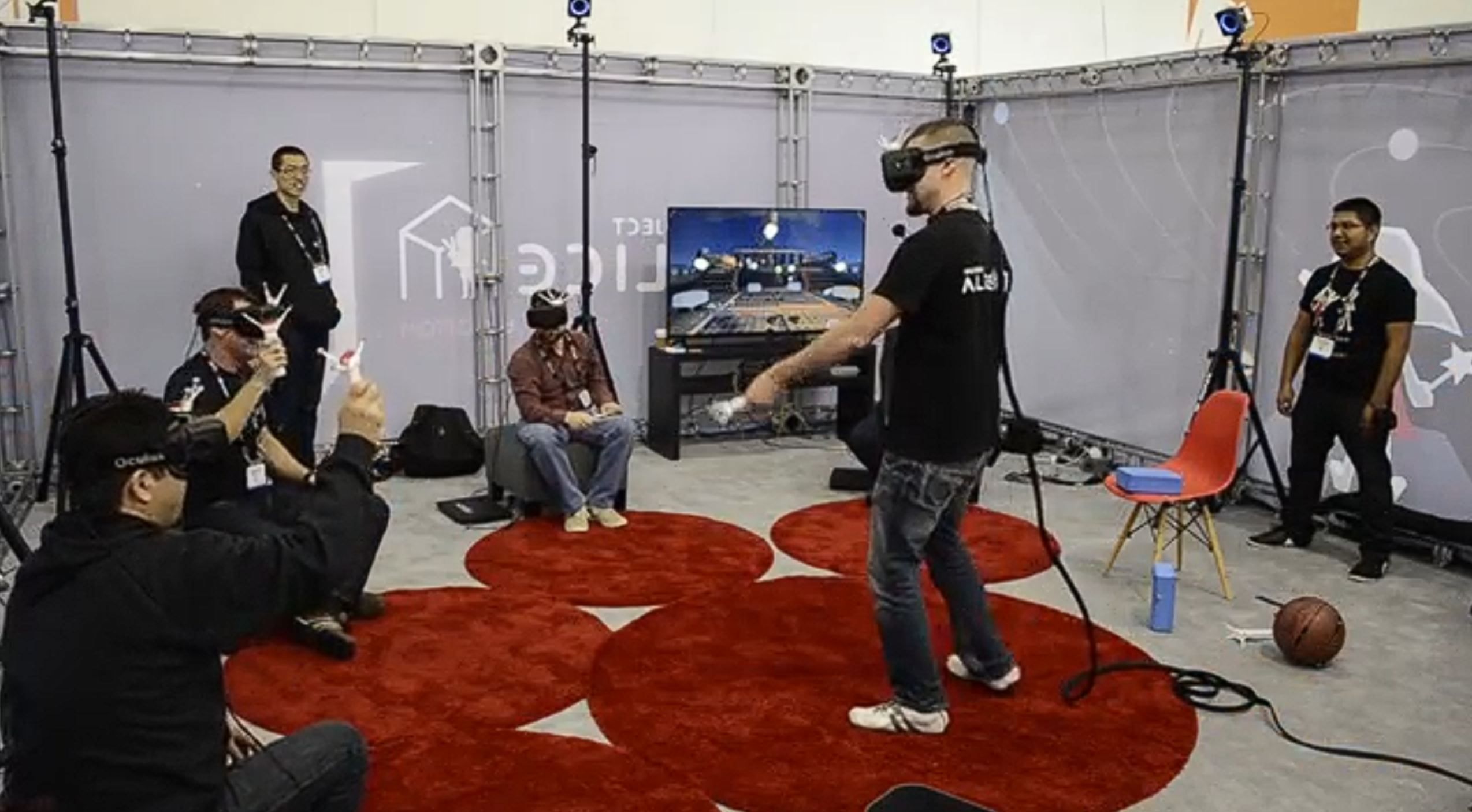
Project Alice is a high-end B2B immersive virtual reality and motion-capture platform developed by Noitom. Rather than a standalone VR game, it is a complete commercial VR system combining HMDs, inertial motion-capture suits, optical tracking, motion gloves, tracked physical props, and backpack computers to create highly immersive multi-user experiences.
Project Alice multi-user VR demo
I joined Project Alice as a Technical Artist intern for a three-month summer internship in 2016. All of my work was created in Unity. The platform had multiple demo experiences, and I contributed to two of them: a low-poly last-stand FPS demo and a stylized system-accuracy showcase.
Table of Contents
Last-Stand FPS Demo
The first demo was a last-stand first-person shooter with a low-poly visual style. Players stood on a physical platform, defended against waves of enemy robots, and shot incoming enemies from multiple directions.
My responsibilities covered the full technical-art path for an enemy character:
- Designed an enemy robot within the project's visual and gameplay guidelines.
- Modeled, rigged, and animated the robot in Maya.
- Applied color-based material treatment to match the low-poly art direction, which relied on flat colors rather than texture-heavy assets.
- Imported the mesh and animations into Unity, set up materials, created prefabs, and connected the asset with gameplay scripts.
- Created combat and state-feedback VFX, including projectile, spawn, hit, death, score, win, and lose effects.
- Tested the assets directly with the Project Alice hardware and iterated based on in-headset gameplay feedback.
System Accuracy Showcase Demo
The second demo was a stylized interaction showcase designed to demonstrate the platform's tracking accuracy. Players stood on one side of a toon-style river and threw virtual balls toward targets on the other side, making the demo a clear test of physical motion, object tracking, and virtual feedback.
For this demo, I contributed:
- Stylized environment models, including mountains, rocks, trees, and supporting scene assets.
- Texture work for the environment assets.
- A toon-style river water effect built in Unity.
- Score, win, and lose feedback VFX, including firework-style particle effects.
Hardware Testing and Iteration
Working on Project Alice was an exciting introduction to commercial-scale immersive systems. One of the most memorable parts of the shooter demo was using 3D-printed gun props tracked by the system and mapped directly to the virtual weapons seen in VR.
That workflow made the project more than a content exercise: every asset and effect had to read clearly inside a full-body, tracked, multi-user VR setup. Testing with the actual hardware helped me understand how technical art decisions, interaction design, tracking fidelity, and real-time performance all connect inside an immersive platform.